Feed Your Gut, Not Your Cravings
How the Gut-Brain Connection Shapes Your Energy, Mood, and Health
Let me be honest with you.
Lately, I’ve been feeling exhausted.
Not just a little tired, but deeply fatigued, despite sleeping well, training regularly, and living the healthy lifestyle I always recommend.
It didn’t make sense.
I kept asking myself:
“How can I feel like this when I’m doing almost everything right?”
Then I remembered.
A few days earlier, while on holiday, I bought a box of Ferrero Rocher chocolates.
One or two? Absolutely fine.
Instead, I ate almost half the box.
That single moment of excess was enough to throw my body off balance.
It reminded me that health isn’t just about making good choices, it’s also about avoiding excess.
But then I asked myself a more important question:
Why did I crave chocolate so badly?
The answer surprised me.
I wasn’t craving chocolate.
I was missing my family.
Sometimes we try to feed our emotions with food, when what we truly need is connection.
That experience brought me back to one of the most fascinating topics in modern health science: the gut-brain connection.
Reading The Mind-Gut Connection by Dr. Emeran Mayer completely changed the way I understand health.
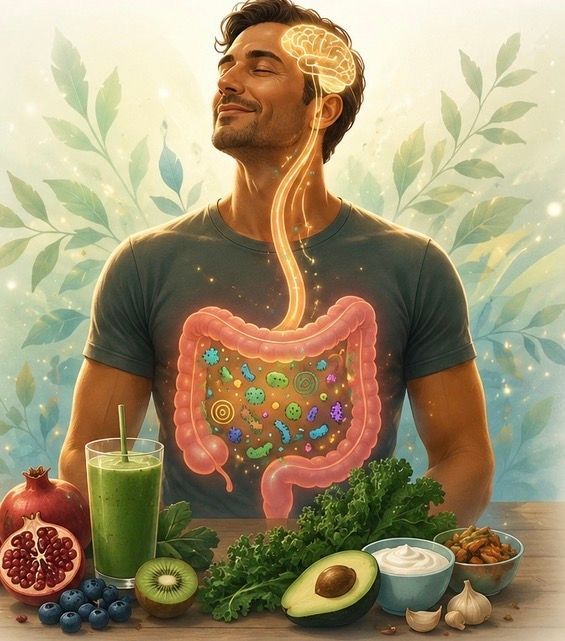
Our gut is home to trillions of microorganisms that communicate constantly with the brain through the gut-brain axis, influencing digestion, immunity, metabolism, mood, recovery, energy, and even our cravings.
Scientists often call it our second brain and for good reason.
Why Your Gut Matters
Have you ever noticed that two people can eat the same meal, yet one feels energized while the other feels bloated and tired?
One major reason is the health of their gut microbiome.
A healthy microbiome helps your body:
- Absorb nutrients efficiently
- Produce more energy
- Reduce inflammation
- Strengthen immunity
- Recover faster
- Improve mood and mental clarity
You’re not only what you eat, you are what your body is able to absorb.
Meet Your Inner Allies
Your gut contains trillions of bacteria, but these four are among your greatest allies.
Akkermansia – The Gut Guardian
Supports the gut lining and metabolic health.
Feed it with: pomegranates, berries, green tea, cocoa (85%+), and other polyphenol-rich foods.
Bifidobacterium – The Fiber Lover
Transforms fiber into compounds that nourish your gut.
Feed it with: garlic, onions, leeks, asparagus, chicory root, oats, apples, and bananas.
Lactobacillus – The Fermented Friend
Supports digestion and microbial balance.
Find it in: kefir, natural yogurt, kimchi, sauerkraut, miso, and fermented vegetables.
Faecalibacterium prausnitzii – The Anti-Inflammatory Champion
Produces butyrate to help keep the gut lining healthy. It serves as the primary energy source for colon cells, helps maintain gut barrier integrity, and exhibits powerful anti-inflammatory and metabolic
Support it with: lentils, chickpeas, beans, flaxseeds, chia seeds, walnuts, and leafy greens.
Feed Your Ecosystem, Not Just Yourself
One of the biggest mistakes people make is eating the same foods every day.
Your microbiome thrives on diversity.
The more colorful fruits, vegetables, herbs, spices, legumes, nuts, seeds, and fermented foods you eat, the healthier your internal ecosystem becomes.
One of my favorite gut-supporting smoothies contains:
- Kale (including the stems)
- Mixed berries
- Half an avocado
- Coconut water
- Extra virgin olive oil
- Super Greens powder
Sometimes I add kiwi or strawberries for extra vitamin C, antioxidants, and digestive enzymes.
This simple smoothie provides fiber, polyphenols, healthy fats, minerals, antioxidants, and plant compounds that nourish your beneficial bacteria.
Don’t Fear Healthy Fats
Healthy fats have been unfairly criticized for years.
In reality, they’re essential.
They help absorb vitamins A, D, E, and K, support hormone production, protect your cells, and keep your brain functioning optimally.
Choose foods like:
- Extra virgin olive oil
- Avocados
- Nuts
- Seeds
- Fatty fish
Your brain and your gut will thank you.
Feed Your Gut, Not Your Cravings
My experience reminded me that not every craving is a sign of hunger.
Sometimes it’s stress.
Sometimes it’s loneliness.
Sometimes it’s poor sleep.
Sometimes it’s emotional fatigue.
Before reaching for food, pause and ask yourself:
“What do I really need right now?”
Maybe it’s food.
Maybe it’s sleep.
Maybe it’s movement.
Maybe it’s fresh air.
Maybe it’s a phone call to someone you love.
Learning to recognize the difference may be one of the most important habits for lifelong health.
Every Meal Is a Message
Every meal sends a message to your body.
You are either feeding the bacteria that help you thrive or creating an environment that encourages imbalance.
No one is perfect and it is not about having a perfect diet but to be aware
Then consciously you act with prevention
Feed your gut, not your cravings.
Your microbiome is your greatest ally. Always keep in mind that you are never truly alone. The bacteria within you can work for you or against you; it all hinges on how well you nourish them.